The access control and door entry market is constantly striving to develop and improve levels of security and more convenient identity authentication methods – and the growing trend for biometric validation ticks all the right boxes.
Using your own unique ‘biological identity’ as an authentication key and negating the need for any physical unlocking ‘device’ (ie. keys, fobs, ID cards, etc) can help to provide the most secure and effective solution for access control and door entry in a wide variety of residential and commercial property applications.

Biometrics in Access Control and Door Entry
What is biometrics?
Biometrics is biological measurements or physical characteristics that are used to identify individuals.
What is Biometric Security?
There are three types of biometric security:
- Biological biometrics uses genetic traits. These include features such as DNA or blood, which can be accessed through a sample of your body’s fluids.
- Morphological biometrics involves your body structure. Physical traits such as your eye, fingerprint, or the shape of your face can be mapped for use with security scanners.
- Behavioural biometrics use patterns that are unique to each person. For example how you walk, talk, or even type on a keyboard can indicate your identity if the patterns are tracked.
How does Biometric Security work?

Biometric or physical characteristics are relatively unique. Each person’s biometric identity can be used as password systems for computers, phones and to restrict access to rooms and buildings. In simple terms biometric security means your body becomes the ‘key’ to unlock and gain access.
Once biometric data is scanned and mapped, it is then saved to be matched with future attempts at access. Most of the time, this data is encrypted and stored within the device or on a remote server.
What are the benefits of biometric security?
- Biometric security is convenient as there is nothing to forget or lose as you are the ‘key’.
- Biometrics is difficult to be stolen or impersonated unlike a password or physical key
What biometric security methods are there?
 |
|
 |
|
 |
|
|
|
|
|
|
|


Fingerprint Entry
 What is fingerprint entry?
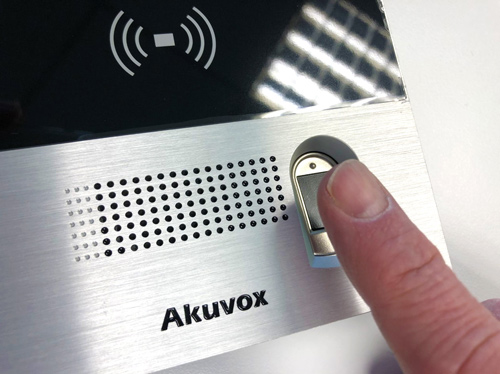
Fingerprint Entry is a form of biometric access control; it uses a fingerprint reader to scan each individual registered user’s unique finger print for identity verification and matches it to pre-stored data.
How does fingerprint entry work?
Fingerprint entry systems work by reading a person’s fingerprint, which will then be compared with a pre-scanned dataset of your fingerprint. The system will then either identify a match or not. The response will send a signal to the door, which either allows the permitted individual access into a secure area, or remains closed.
What are the benefits of fingerprint entry?
- Everyone’s fingerprints are unique, therefore fingerprint entry is a more trustworthy method of identification than other forms of entry such as key cards that can be lost, stolen or borrowed.
- With the advancement of different security methods in recent years, fingerprint entry systems are now much more affordable and advanced.
- They are a quick and simple system to use.
- Biometric systems such as this can be set up so everyone is limited to their own individual level of access to areas/doors.
Are fingerprint entry systems secure?
Unlike traditional entry methods such as keys and pin codes which can be shared with others, fingerprint entry is nearly impossible to forge, misplace or fake as it is unique to the user. The information that is used to identify your fingerprint is also encrypted, which protects it from thievery or duplication.
Iris Recognition
 What is iris recognition?
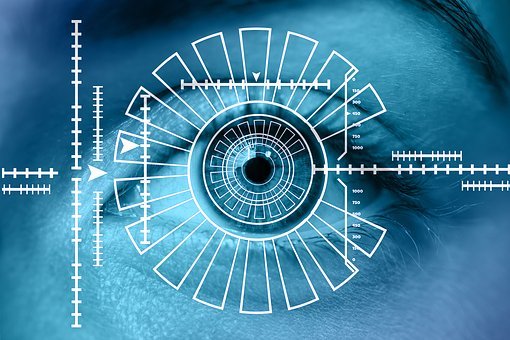
Iris recognition or iris scanning involves the use of a specialised digital camera. The camera uses both visible and near-infrared light to take a clear, high contrast picture of a person’s iris and measures the unique patterns in people’s eyes.
How does iris recognition scanning work?
Iris scanners work by illuminating the iris with infrared light to pick up unique patterns that are not visible to the naked eye. The scanners detect and exclude eyelashes, eyelids, and reflections that typically block parts of the iris. The results in a set of pixels containing only the iris. The pattern of the eye’s lines and colours are also analysed to extract a bit pattern which encodes the information in the iris. The bit pattern is then digitised and compared alongside the stored templates in a database for verification.
Is Iris Recognition secure?
Iris scanning is an extremely secure option as your iris’ physical structure contains a pattern that is unique to each individual and is virtually impossible to replicate.
What are the benefits of Iris recognition?
- Iris Recognition is one of the most accurate forms of biometric authentication
- It provides a contactless solution making it more hygienic to use and less intrusive to the end user.
- Iris recognition is extremely flexible. The infrared camera means the scanner can also be used at night or in the dark.
- The technology in the iris scanner can detect movement of the iris which identifies the liveness of the individual; this reduces the risk of forged access through high quality static images.
- If a user is already registered in the biometric system, Iris Recognition is one of the fastest forms of biometric identification.
Facial Recognition
What is facial recognition?
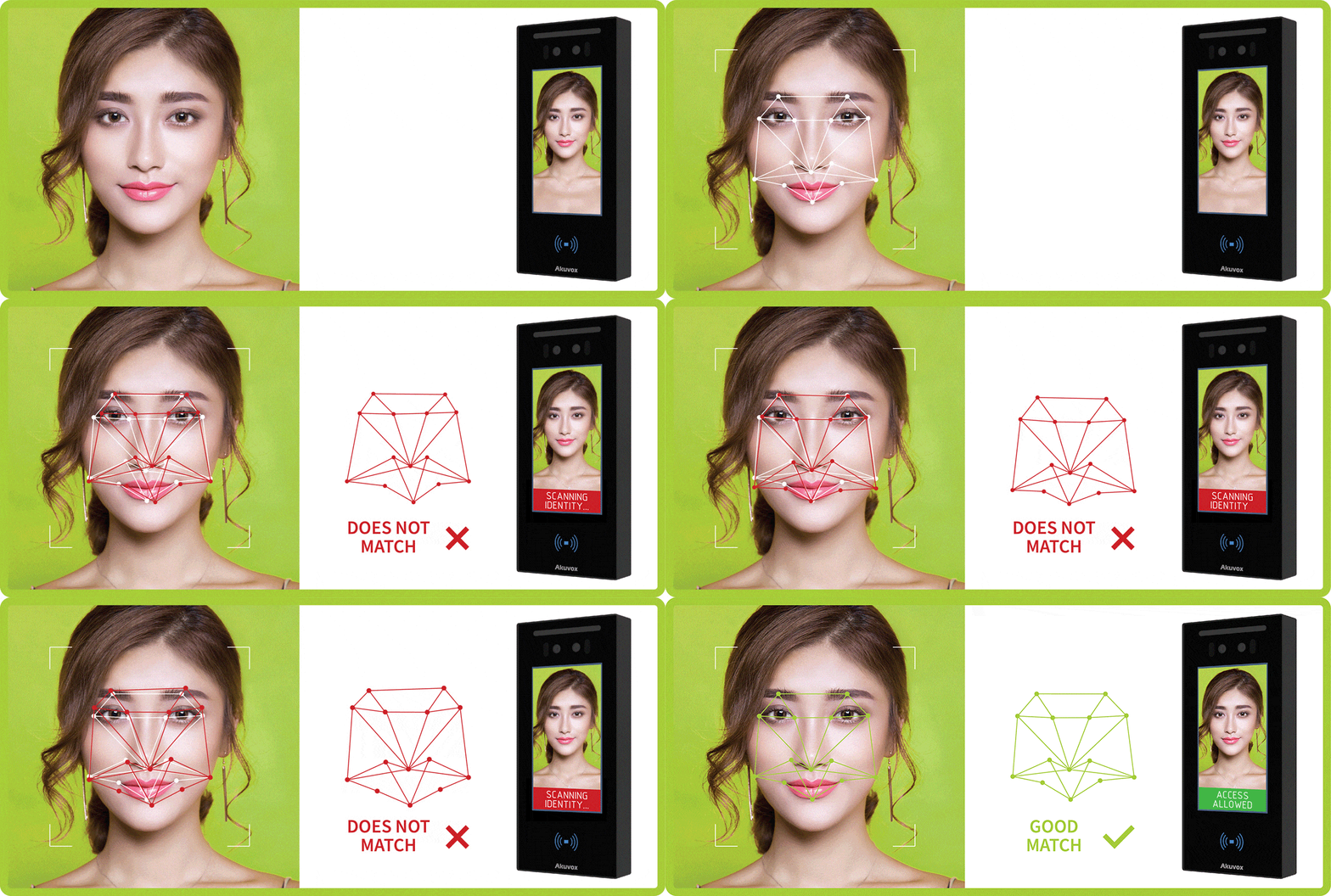
Facial recognition is a technology that matches human faces from a mapped identity stored against a database of different faces.
How does facial recognition work?
Facial recognition systems use algorithms which map hundreds of unique details of an individual’s face. Details used are things such as the distance between a person’s eyes; these details are then compared to the data stored in the facial recognition database.
What are the benefits of facial recognition being used in Access Control and Door Entry?
- Offers hands-free user authentication
- Helps improve security
- A fast, convenient and remote management of user IDs
- No authentication device is required
- Integrates with other platforms
Is facial recognition secure?
Facial recognition in general is classed as being more secure than for example the ‘guessable’ pin code/password. This is mostly down to the fact that is it harder to hack. But like every security method nothing is ever 100% risk free. With facial recognition there is a potential that it can be spoofed, though developing technologies now feature vastly-improved anti-spoofing software and AI systems.
Find out more about facial recognition in access control here
Voice Recognition
What is voice control?
Voice control or voice recognition means you can control your device with spoken instructions, providing a frictionless (or ‘contactless’) system. In addition, voice recognition can be used for identity authentication in access control.
What can voice control do?
You can use voice control for things such as access control, unlocking/locking doors, answering texts/call people hands free, turn lights on, close curtains and turn heating on/off.
Examples of voice control software:
- Alexa – Amazon voice control software
- Siri – Apple voice control software
- Albert – Akuvox new voice control software
- Cortana – Microsoft voice control software
Find out more about voice control in access control here
Body Temperature Detection
 What is the average body temperature?
The average body temperature is 36.5 – 37.5 degrees centigrade however this varies from person to person. Anything over 38°C is classed as a fever and anything less than 35 degrees is classed as hypothermia.
Why use body temperature detection for access control?
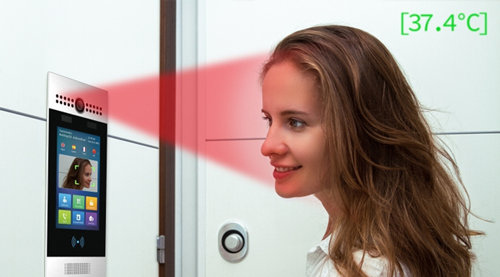
Using body temperature detection for access control helps keep control of virus’s spreading by detecting high temperatures of people at entrances and restricting entry to anyone presenting above the ‘safe’ temperature range.
Main entrances and staff access points such as hospitals, factories and schools are increasingly using staff resource to manually test all people entering the building for fever-like symptoms using handheld infrared thermometers. The manual testing for body temperature, however, takes up valuable human resource and puts staff at risk of virus and disease transmission.
Whereas using an intercom device (such as the Akuvox R29C-B intercom) with built-in temperature detection provides a fully-automated first line of defence to highlight anyone entering the building that may be symptomatic of a virus. The system can be set up to highlight specific temperature ranges and, where required, deny access to anyone presenting above the ‘safe’ temperature range.
Applications for temperature controlled door access:
- Hospitals
- MDUs and apartments
- Offices
- Schools, colleges and universities
- Doctors’ surgeries
- Factories and distribution hubs
Find out more about body temperature detection in access control here