 What is 100v Line Audio?
100v line (or 70v line in the US) also referred to some times as High Impedance or Constant Voltage.
100v line is the most common distributed sound system for commercial applications, particularly public address (voice) and background music systems where long distance transmission and large numbers of low level output loudspeakers are the common characteristics.
100v line has a more limited frequency range than low impedance audio, which is the reason for it’s popularity for voice and low level music applications. However, with this frequency range limitation, 100v line is not suitable for foreground, high power or hifi music reproduction.
What are 100v Line tappings?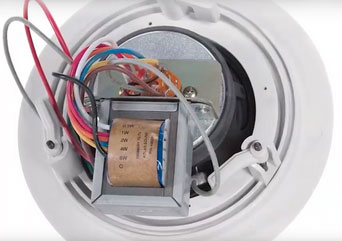
70v or 100v line loudspeakers feature a line transformer which steps up the audio outout sugnal 100 volts (or 70 volts!) so that the transmission line current for the chosen power output is relatively low. This reduces signal loss and allows lower grade / smaller diameter cables to be used.
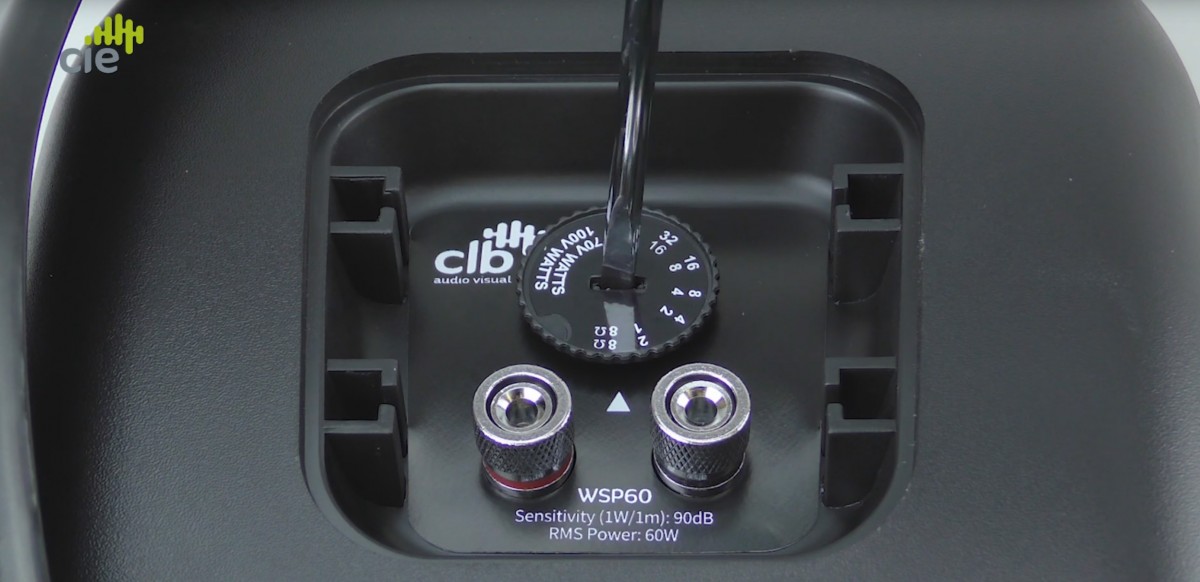
100v line loudspeakers will also often feature a ‘tapping’ settings – either in the form of a rotary switch or as part of the audio connection terminals.
The tappings set the loudspeaker output at what is called a ‘wattage tapp’ (technically it’s setting the transformer at a specific impedance, but in simple terms, the result is the relative wattage output level!), which allows the audio installer to alter the speaker output levels to address the issues of it’s environment or positioning.
Understanding 70v / 100v line Loudspeaker Tappings
Why do we need to use speaker tappings?
Often a building may have different acoustics in different areas or have differing ceiling heights and is such cases, different speaker output levels will be required in different areas. However, the client may wish to use the same speakers throughout the building. Therefore, by changing the speaker tappping (higher or lower) allows the output – in effect the volume from each speaker to be set according the needs of each specific position or zone.
In addition, large open plan working spaces for example, may feature the smae cieling speakers throughout, but there are different zones on the floor where high or low noise levels require the speaker levels to be different. Speaker tapping allow a simple change of audio output level to suit the needs.
Where are loudspeaker tappings used?
Loudspeaker tappings are available on most 100v / 70v line / high impedance loudspeakers (ceilling speakers, horns, columns, wall speakers etc) and are found on the rear of the units.
As 100v line audio is most common in commercial applications for voice reinforcement, public address and background music, speaker tappings are normally used in offices, schools & universities, factories, restaurants, etc.