You will probably have heard this question (and probably wondered yourself!) many times; ‘Are all HDMI cables the same?‘.
And you will see a huge amount of comments suggesting that they are!
But in the AV world of increasing bandwidth requirements for 4k, 8k and data transmission rates now topping 48Gb, there is a need for higher performing HDMI cables – and, therefore, specified HDMI Standards to ensure different cable types achieve the various specifications.
|
HDMI STANDARD |
Bandwidth (up to) |
AV Capabilities |
|---|---|---|
| Standard HDMI | 4.95Gbps | 1080p |
| High Speed HDMI | 10.2Gbps | 4K24 (4K 24 fps), HDR, wide colour gamuts |
| High Speed HDMI with Ethernet | 10.2Gbps | 4K24 (4K 24 fps), HDR, wide colour gamuts, additional Ethernet channel |
| Premium High Speed HDMI | 18Gbps | 4K60 (4K at 60 fps), 4:4:4 chroma sampling, 8K at lower frame rates |
| Ultra High Speed HDMI | 48Gbps | Uncompressed 8K video – 8K60, 4K120 |
Standard HDMI
This obsolete version of HDMI has now been replaced by the higher performance High Speed HDMI, as the ‘base level’ technology.
Standard HDMI can still be used for legacy consumer devices and is capable of reliably transmitting 1080i or 720p.
Still available to some extent, but not recommended as they do not support higher resolutions, refresh rates or latest technology bandwidth requirements.
High Speed HDMI
Now considered as the ‘base-level’ HDMI cable, High Speed is capable of handling 1080p resolutions, as well as display technologies including 3D, Deep Colour and 4K at 30Hz.
Recommended for standard ‘HD’ video devices such as Blu-Ray and previous generation games consoles.
Also available as High Speed HDMI with Ethernet, this version features an additional data channel for networking devices. This Ethernet channel only functions if both linked devices and the HDMI cable are HDMI-with-Ethernet compatible and enabled. However, HDMI-with-Ethernet can be used as a ‘non-Ethernet’ cable as the two versions are interchangeable.
Premium High Speed HDMI
 The ‘Premium’ High Speed HDMI Standard is designed for fully reliable performance for 4k / UHD up to 4K60 (4K @ 60frames per second) and support for HDR (High Dynamic Range) and expanded colour spacing.
Fully-verified Premium HDMI cables are covered by the Premium HDMI Cable Certification Program, which authenticates products to support full 18Gbps bandwidth from the HDMI 2.0b specification with an EMI test to ensure cables minimize interference with wireless signals.
Authentic Premium Certified HDMI cables will feature the assurance label shown here, which includes a QR code to confirm it is approved by the official HDMI Forum.
Comparing different HDMI Standards
Ultra High Speed HDMI
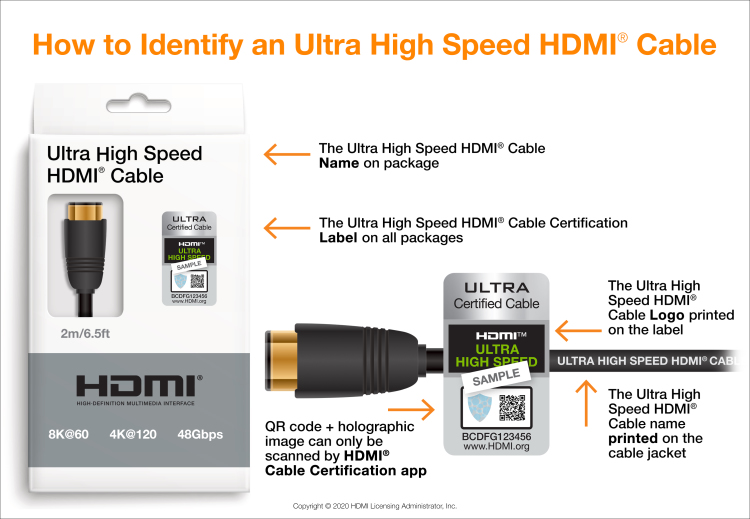
The latest HDMI Cable Standard – Ultra High Speed HDMI – complies with the new Ultra Certification Program, compliant with specifications to support 8k@60 and 4k@120 and bandwidth of up to 48Gbps. It also supports additional video functionality including HDR, VRR, eARC, and all other HDMI 2.1 features.
Similar to Premium HDMI described above, Ultra HDMI products must be approved and labelled as part of the Ultra High Speed HDMI Cable Certification Program, explained in the diagram below:
HDMI 1.3, HDMI 1.4 and HDMI 2.0 versions compared
|
HDMI VERSION |
Transmission Bandwidth |
Resolution |
HDR Support | HDCP Support |
|---|---|---|---|---|
| HDMI 2.0 | 18.0 Gbps | 4K @ 60Hz 4:4:4 | Yes | 2.2 |
| HDMI 1.4 | 10.2Gbps |
4K @ 30 Hz or 4K @ 60Hz 4:2:0 |
No | 1.4 |
| HDMI 1.3 | 10.2Gbps | 1080p @ 60Hz | No | 1.2 |