The longer the line of your audio signal, the more susceptible it’s going to be to interference. So avoiding ‘noise’ on your signal is a key consideration in ensuring high quality performance from your audio system.
What is a balanced audio system?
Balanced audio is used in professional audio systems and uses more rugged connectors such as the XLR and ¼” jack plugs. A balanced audio system will minimise any unwanted external noise or interference that can be picked up in an unbalanced system.
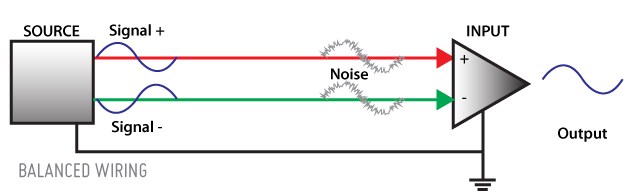
Balanced audio utilises a cable which comprises of two conductors which are twisted together and an overall screen. These are the positive line (the hot), negative line (the cold) and earth (screen).
The audio signal is transmitted on both the hot and cold lines but the signal on the cold line is inverted – providing a signal that is effectively flipped upside down. Along the length of the cable, noise can be introduced from external sources such as power cables or RF interference.
This noise will be identical on both hot and cold lines. At the receiving end the cold line signal is inverted back to its original state and combined with the hot line signal. And this is where the trick of balanced audio kicks in. When the inverted audio is re-inverted to make the hot and cold signals the same, the unwanted noise is also inverted and therefore cancelled out, leaving only a noise-free combined original signal.
The shield of the cable is the first line of defence, with some interference being picked up by the shield and being deposited into the electrical ground of the system before becoming part of the audio signal. The twists in the cable will also help to reject interference.
Balanced signals can therefore be run both over short and more importantly, significantly longer cable runs without the concern of interference.
What is the difference between balanced & unbalanced audio signals?
What is an unbalanced audio system?
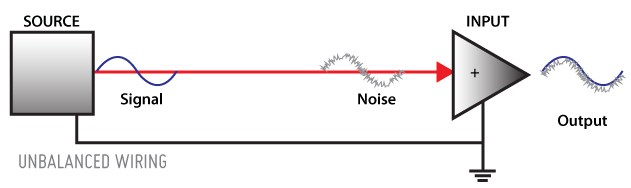
Unbalanced audio signals traditionally use a single core cable with an overall screen. This is often a coaxial type cable and uses the phono or RCA type connector or jack plug to connect audio equipment together.
Unbalanced audio connectors can be found on a whole host of mainly domestic audio equipment such as: CD players, MP3 players and HiFi seperates. The centre conductor in the cable is called the positive or hot line and the screen of the cable is the earth.
The audio is carried on the centre conductor as well as the screen of the cable. With unbalanced cables any interference is easily picked up and will be audible. Interference can be anything from an annoying hum picked up from local electrical sources to radio stations and taxi company radios.
So unbalanced signals are a low cost solution normally used for interconnection of audio equipment that is located close to each other, normally within about three metres.