Understanding Class D Amplifiers
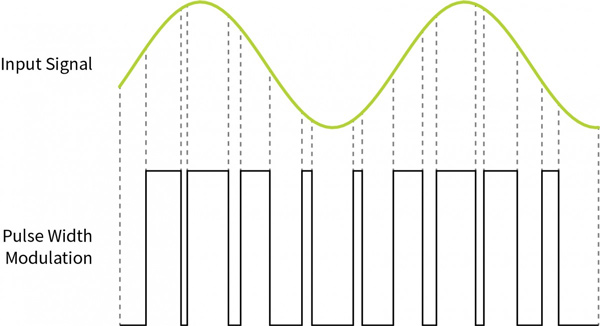
A Class D Amplifier is also known as a ‘switching power amplifier‘. Class D amplifiers work off pulse width modulation, it converts the input signal into a stream of pulses.
Class D Amplifiers are often misinterpreted as digital amplifiers – or at the very least – ‘two levels better’ than a conventional Class A amplifier.
The reality is that Class D technology is increasingly being adopted for traditionally bulky heavy and inefficient power amplifiers in large scale public address, voice reinforcement and live sound systems.
Pulse width modulation diagram example:
What are the benefits of a Class D Amplifier?
Pros
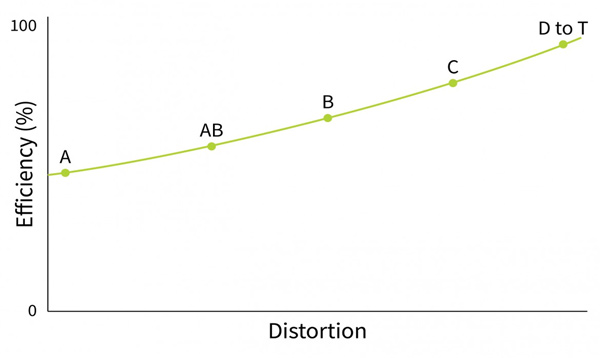
- They are efficient – unlike Class A Amplifiers which are constantly at full power, Class D Amplifiers power switches on and off.
- They can be smaller as they do not have a big transformer and capacitors.
- Easy to install and easy to store away as they don’t get hot like a Class A Amplifier would.
- Does the job for most things!
Cons
- Some people do not like the sound the Class D Amplifiers give as it can sound very digital.
Efficiency v.s. Distortion diagram:
What is a Class D Amplifier?
What is a Class A Amplifier?
Class A Amplifiers are the most common used and simplest form of a power amplifier, they have both output stages of the device constantly at full power.
Conventional analogue amplifiers are extremely reliable but are well known for their weight and bulk due to the copper wirings of the transformer(s) – and ofcourse, the more powerful the amplifier the larger and heavier it will be.
So in large scale PA and sound reinforcement systems – often with 1000’s of watts of output and multiple channels – the resulting audio rackbuild quickly becomes quite significant, to the point of 300 high racks requiring lifting equipment to position them in the final resting place!
And as an inefficient technology, conventional analogue amplifiers develop a lot of heat which needs to be managed – requiring even more space and energy for temperature conditioning.