How is Bluetooth technology used in Access Control?
Bluetooth is an ideal technology for contactless mobile credentials for access control and door entry.
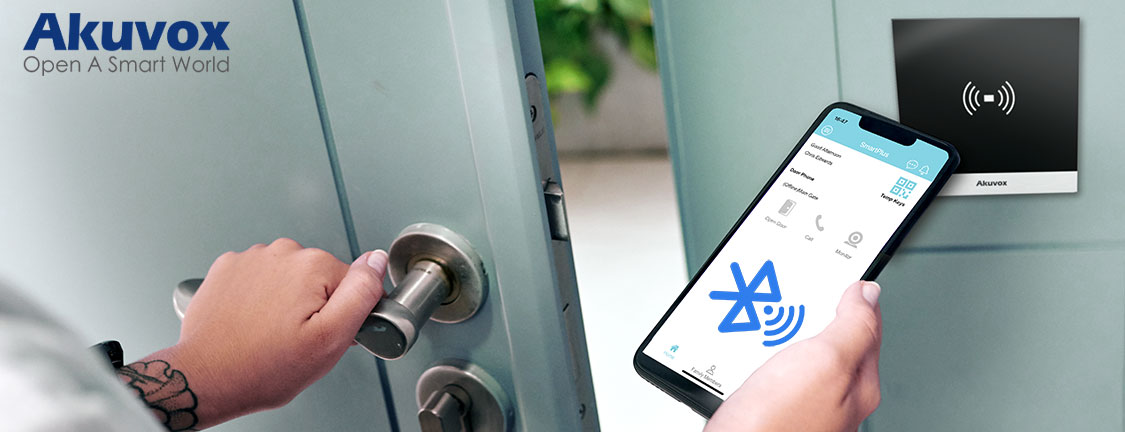
Bluetooth door entry utilises each individual user’s smart phone with installed app for wireless transmission of access credentials and a Bluetooth Access proximity reader to receive the signal. When the device is near to the Access reader, the application communicates with the reader and exchanges the security key to authenticate and opens the lock to allow entry.
What is Bluetooth Low Energy (BLE)?
BLE (Bluetooth Low Energy) is also known as Bluetooth 4.0. When comparing Bluetooth Low Energy with standard Bluetooth, the main difference is in BLE’s low power consumption. With Bluetooth Low Energy’s reduced power consumption, applications can run on a small battery for up to 5 years. This is vital for applications that only need to exchange small amounts of data periodically.
In Access Control applications, therefore, BLE helps to significantly increase the battery life for users’ smart phones (compared with standard Bluetooth transmission).
In addition, as wireless, battery-powered access readers enter the market, Bluetooth Low Energy will become the transmission technology of choice for increased battery life.
Exactly the same as Bluetooth, BLE operates in the 2.4 GHz ISM band. However unlike original Bluetooth, BLE stays in rest mode until a connection is initiated. BLE’s actual connection time is a few mS, whereas Bluetooth takes around ~100mS. The reason the connections are short, is that the data rates are so high at 1 Mb/s.
What applications use BLE Bluetooth technology?
There are a gorwing number of applications and devices making use of Bluetooth BLE technology in order to benefit from the contactless and low energy characteristics.
And as more and more devices become ‘smart’ or interactive, wirelss connection our smart phones becomes an expectation, rather than a novelty.
BLE is already commonly used in systems such as:
- Access Control and Door Entry
- Blood pressure monitors
- Fitbits, smart watches and other body-worn devices
- Industrial monitoring sensors
- Area-based and targeted promotions (iBeacons)
- Public transportation apps
How to use Bluetooth for door unlocking from a smart phone
In order to use your smart phone for contactless authentication with an access control or smart lock system, you will need to install the manufacturer’s app on your phone, which will be linked to your unique account on the system’s remote / cloud hosted environment.
Most access control smart phone apps will feature a number of functions, such as remote viewing of your access or intercom’s camera, remote unlocking if you have visitors and you are out at the time, temporary key generation, etc.
In addition, the smart phone app will be used as your identity authentication for wireless access methods such Bluetooth and NFC.
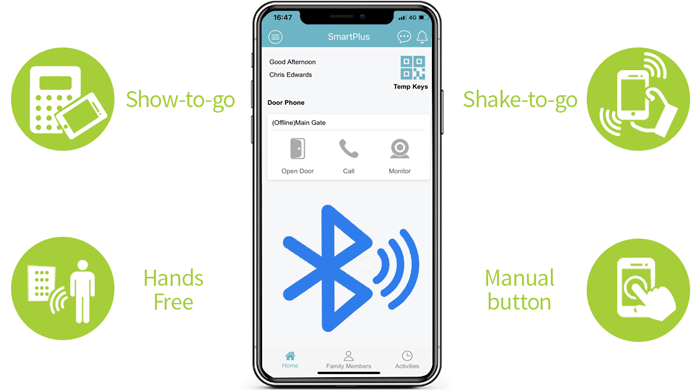
Most apps will allow various activation functions to transmit to the access / smart lock receiver, such as:
- Show to Go – this function would normally be applied for QR code access; when a QR code is generated as a temporary key (perhaps for deliveries or service staff)
- Shake to Go – most latest-generation smart phones feature motion control which can be used to activate a Bluetooth authentication command from your phone to the reader
- Hands Free – Bluetooth authentication can be set-up as ‘always on’ on your smart phone; by pressing the access reader calls for an identity verification command
- Manual Button – some apps will require a simple press of a button on the app to transmit a Bluetooth authentication command
What is Bluetooth BLE Access Control?
What is the difference between Bluetooth and Bluetooth Low Energy?
Bluetooth and Bluetooth Low Energy are used for different purposes. Bluetooth can handle a lot of data however it takes up battery life quickly and costs a lot more. BLE on the other hand is for applications that don’t need to exchange large amounts of data, and therefore run on battery power for years at a cheaper cost. Which one you use depends on the end goal of what you are trying to accomplish.
Why are smart phones being used in access control?
Access control authenticates a person using one (or a combination of) three main attributes:
 |
|
 |
|
 |
|
Smart phones use one or a combination of these authentication methods, meaning a mobile phone’s credentials stay protected behind a smart phone’s security parameters, such as biometrics and PIN numbers. Once an authentication method is entered to access the phone, the user automatically has set up 2-factor access control verification.
You can’t have access to the Access Control credentials without having access to the phone first. So if the phone does not work, the Access Control credential will not work. The credential works the same as other apps on the phone. The phone must be turned on and unlocked for it to be used.
The availability and built-in multi-factor verification are the 2 main reasons why organisations want to use smart phones in their upcoming access control implementations along with the fact that the maority of people own and use a mobile device nowadays.
What are the advantages of using Bluetooth in Access Control?
- Bluetooth readers have lower running costs in comparison to RFID readers. With the user’s smart phone being the authentication device, there are no costs involved in supplying and delivering RFID cards, keyfobs, etc.
- Bluetooth Low Energy is very efficient and can significantly extend the battery charged time of smart phones (compared with standard Bluetooth).
- Bluetooth’s read range can be from an inch to over 15 feet. This means installers can provide adjustable read ranges and change them for different applications. For example, they could choose a reader requiring 1 metre range at the front door. But for entering the facility gate, a longer read range could be provided of around six feet, so that users do not have to lean out of their car window to reach the reader.