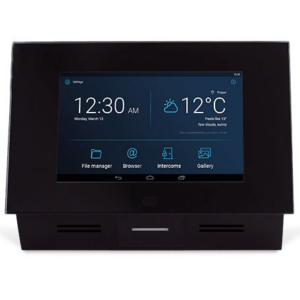
What is RS-232 Control Protocol?
CIE’s HowToAV.tv takes a look at the technology and its place in an integrated world…
Integration and whole system control is now becoming commonplace in both residential and commercial AV systems and, therefore, we’re seeing RS-232 present on the majority of high-end audio visual equipment.
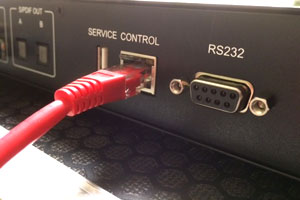 It stands for ‘Recommended Standard 232’ and the connection in Audio Visual equipment is commonly a 9 pin D sub connector, shown on the back of this device here.
Significantly in the AV industry, RS-232 does not transmit audio and video signals, but is used specifically for control of devices in an AV system; so source devices such as some BluRay players and digital media players, display devices such as televisions and projectors, as well as signal control products such as signal splitters and matrices.
And you’re not just limited to residential AV systems, as video wall and digital signage systems also frequently support RS-232 connectivity and control.
Furthermore, if we consider the wider scope for system and home automation, non-AV devices such as lighting, motorised blinds, access control, heating and air conditioning systems are now readily available with RS-232 support.
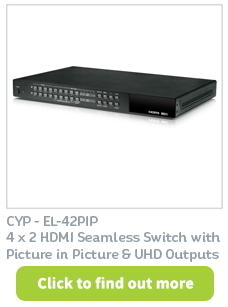 So how do you control an RS-232 supported device?
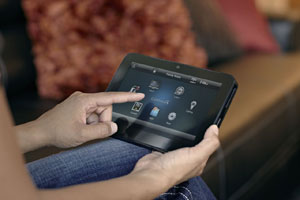
In simple terms, an RS-232 connection on a projector, for example, allows you to control the device remotely using a third party interface, such as a Macro Wall Controller, PC-based control software or a touch screen device such as an iPad or Android tablet connected to a control processor. The level of control depends only on the limitations of the device itself. For example on a projector it could be… Turning the projector on, changing the channel input, or changing the resolution and so on…
Another key advantage of using RS-232 as a control protocol, as apposed to Infra Red; is that RS-232 offers feedback or two way communication between the control hardware sending the command and the device being controlled.
In contrast, when you send an IR command from a remote location, you have no idea if that command has actually done what it was intended to do. For example, from a central rack cabinet you could send an IR command telling all TVs within a specific location to turn off. If for some reason the command does not reach the displays, you have no idea which screens are switched off or not. With this example, RS-232 can report back to the control system if the command has successfully reached its destination or not.
 RS-232 connectivity is often one of a number of control options on your devices, so you’ll still be able to control by pushing good old buttons on the front of your unit! – and in most cases it’s likely to also support infrared (or IR) remote control.
But when you’re looking to provide a remote or integrated system control where some form of system status feedback is essential, then RS-232 is usually the more favoured option.
All the big players in the home and commercial control world such as AMX, Crestron, Control4 and Savant have the option to control devices via RS-232 in some shape or form.
With your devices connected to a control system via RS-232, there is the ability for a huge range of control options: switching between source and display device; changing channel, volume, light level and colour, opening and closing blinds and controlling temperature levels are just a few of the options only limited by each specific device and the programming of your chosen control interface.