QR Code technology in Access Control & Door Intercoms
What is QR Code Access Control?
There is an increasing range of options for identity authentication being adopted for access control and door entry systems – with ‘keyless entry’ and ‘contactless’ or ‘touch-free’ technologies being the focus of latest-generation devices.
QR Codes are emerging as an ideal authentication option for door entry systems – particularly for temporary applications and time-limited access permission situations such as managing entry for cleaning staff, contractors or deliveries when access to the building may be restricted to certain days of the week, certain times of the day or simply for one-time-only use.
 What is a QR Code and how does it work?
 QR Codes (abbreviation of Quick Response Codes) are similar to conventional bar codes, but are much more flexible and, due to their 2-dimensional structure, are able to hold much more data (QR codes are able to hold up to 2500 characters, compared to a standard bar code’s limit of just 43, therefore allowing for much longer URLs or text / character strings).
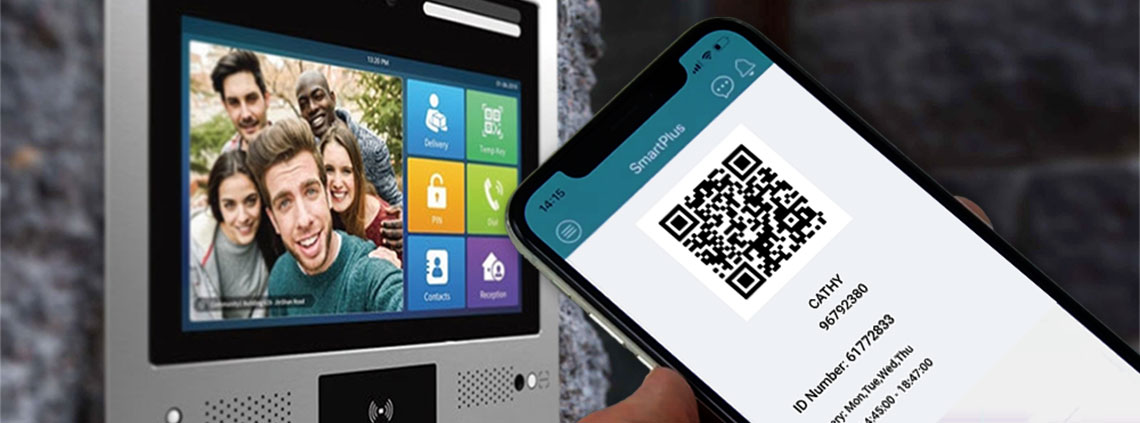
In the case of access control via QR codes, typically the entry system will include PC software or a smart phone App which can quickly and easily generate a unique QR code which can be set to allow access for a limited time period, specific days of the week, limited number of uses and entry limited to specific areas, floors or zones of the building.
Once the QR code has been generated, it can be emailed or messaged directly to the recipient (the user who requires temporary access to the building) for them to display on their smartphone device or print out if required.
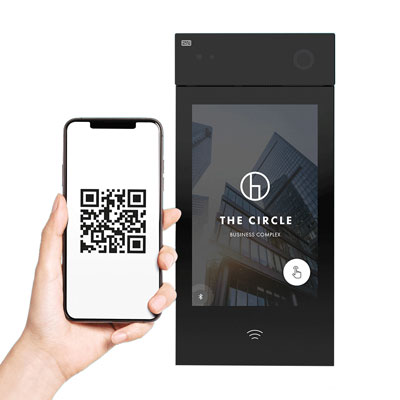
A QR code-enabled Access Control or Door Intercom device will feature a scanner (in the form of a built-in camera); the user simply displays the received QR code from their smart phone to the access control device which will automatically scan it to confirm access rights within the specified time/useage criteria.
Benefits of QR Code enabled Access Control
-
Keyless Door Entry
Keyless Door Entry is increasingly popular for its flexibility both for the user and system administrator. Unique QR codes can quickly and easily be generated from a smart phone or PC app and emailed to the user in any location around the world – no physical ‘key device’ is necessary.
-
Immediate access code generation
An access QR code can be generated and distributed in a matter of seconds.
Imagine, for instance, if a visitor arrives early and you’re not home to let them in, or a high-value package is delivered that you don’t want left outside the front door. Simply generate a unique, time-limited entry QR code and send it to your visitor who can immediately scan the code from their smart phone to unlock the door without having to wait for your return home.
-
Remote Access Management
Where high numbers of users and frequent temporary access permissions requires a significant amount of system management and administration, the ability to create and distribute access QR codes remotely from anywhere in the world allows for a highly efficient system management solution.
-
Flexible, temporary access permissions
Access QR codes can be set for time-limited and number-of-use limited entry – ideal for one-time-only delivery access or cleaning contractors, for example, who only require entry on a specific day of the week.
-
Contactless / touch-free door access
By scanning the QR code from your smart phone supports the trend for contactless door entry to help prevent the transmission of germs and viruses.
-
Reduced carbon footprint
QR codes effectively provide a ‘virtual key’, removing any requirement for physical keys, single-use plastics such as ID cards or keyfobs, or printing on paper; thereby providing a notable reduction in overall environmental impact from your security system.
-
Cost effective
This virtual key option reduces staff resource requirement, distribution time and the requirement for physical identity to key devices, thereby significantly reducing ongoing costs.