Choosing the right Microphone
Microphones are most important part of any audio system. Using the wrong microphone or using it in the wrong way can lead to audio problems regardless of how good the loudspeakers being used are or if the rest of the system is incredibly sophisticated. Therefore, using the most appropriate microphone is essential.
How do I choose the right Microphone?
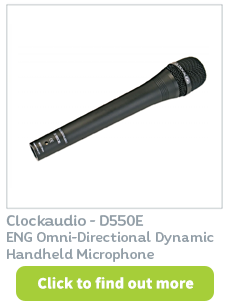 There are a wide variety of microphones available to choose from, so selecting the best microphone for a specific use may become confusing. In terms of directionality, you only want certain sounds to be picked up by the microphone, such as the voice of the speaker but not the noise coming from an air conditioning unit.
A strong acoustic input with a good signal to noise ratio is required in order to be able to sufficiently amplify the signal so that it can be heard clearly throughout the room and also to minimise the risk of feedback. Achieving a good signal to noise ratio often depends on the acoustic environment and the choice of microphone.
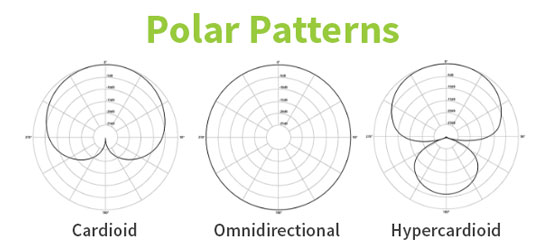
In order to help meet all of the above requirements, microphones have been designed with directional properties. There are three main types of pick up polar patterns:
- Cardioid – predominantly pick up sound from one direction
- Hypercardioid – predominantly pick up sound from one direction.
- Omnidirectional – picks up sound from all directions at once.
None of these properties are perfect. Cardioid means heart shaped which describes the pick up pattern, it picks up sound from the front but also a bit from the sides. In the AV world, it is very common to use a cardioid microphone for picking up speech from a presenter.
Polar Pattern examples
Which Microphone do I need?
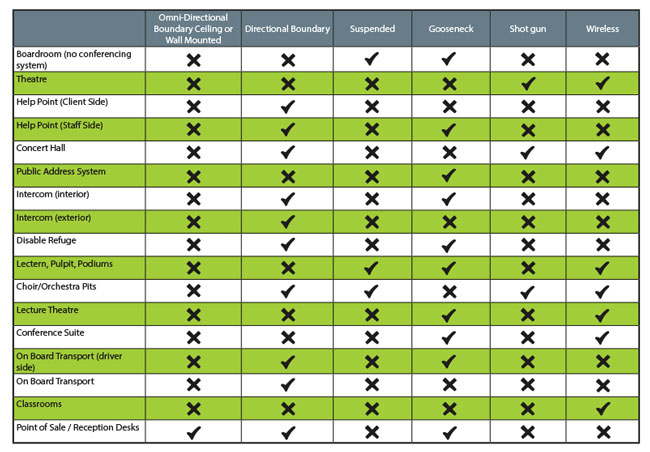
The table below shows a summary of microphone types and applications that they are suitable for. Some other microphone types may be possible to use in certain scenarios, please ask for advice beforehand if unsure.
What is a Shotgun Microphone?
Shotgun microphones are typically used in recording for TV and film as they are excellent for picking up sound from long distances away. Their characteristic long design is known as an interference tube. The microphone capsule is mounted at the end of a long hollow tube with carefully positioned slots along its neck. These slots allow sound to enter the tube, this results in cancellation of unwanted sound that is not coming from where the microphone is pointing at. Generally, the longer the interference tube is the more directional the microphone will be.
How do Microphones work?
All microphones work in a similar way. They all have a diaphragm which is comparable to the human ear drum. When sound hits the diaphragm it vibrates and this vibration is then turned into an electrical signal  which goes through to the rest of the sound system.
There are two main methods of converting vibrations into an electrical signal. This differentiates the two main types of microphone:
- Dynamic microphones – The diaphragm in this type of microphone is connected to a small coil of wire so when the diaphragm moves the coil also moves. When the coil moves between the magnet it generates an electrical output. This output is tiny perhaps only two millivolts (two thousandths of a volt). Dynamic microphones can be fairly cheap and their performance is adequate in many situations.
- Condenser microphones – This type of microphone is slightly more complicated, they use the principle of a capacitor to operate. The plate of one capacitor is fixed and the other is the diaphragm. When audio hits the diaphragm it changes the distance between the two plates, this varies the capacitance and results in producing a sound signal. The capacitor is kept charged using a continuous power supply.
Condenser microphones are much more sensitive than dynamic ones. This is because they do not have a physical coil to move and are almost always better quality, especially at high frequencies. However, condenser microphones need to be powered to make them work. In order to avoid having lots of power supplies everywhere phantom power was invented. Usually, phantom power comes from a mixing desk or signal processor, this DC electrical power is sent directly up the microphone cable and is in the range of 9 to 48 volts.
Read more…
• How to connect a microphone to PC