What is AV-over-IP?
What is AV over IP?
AV-over-IP (Audio-Visual over Internet Protocol) is the transmission of audio, video and control signals over a network cable infrastructure for example WAN, LAN or the internet. In comparison to conventional analogue AV environments, AV over IP refers to the use of standard network equipment to switch and transmit video and audio signals.
What is the future of AV-over-IP in the professional AV industry?
Increasingly we are seeing conventional analogue AV, audio and security systems being replaced with IP-based infrastructures, particularly for larger, more complex and longer distance transmission systems. For some installer / integartors, using IP AV technology is a relatively new (and perceived as expensive!) concept; however, with the growing adoption of smart home devices, the concept of technology devices as ‘IP end points’ is becoming much more common and accepted.
Now there is an ever increasing range of IP-based technologies available on the professional AV market from all manufacturers, with products such as video-over-IP / video over ethernet, audio-over-IP, IP intercoms and IP cameras quickly becoming the norm.
And with the expansion of the Internet-of-Things – or IoT – the expectation of both users and integrators for IP-connected devices is growing at a pace.
Analogue AV versus AV-over-IP setups:
In both analogue and IP-based AV environments, the requirements and hardware elements are very similar. The objective of an AV facility is to give users the capacity to see as well as hear their video and sound sources on their viewing stations and on their sound systems/speakers. To do this, sources should be captured, moved, switched and displayed. The user interface to change sources can be buttons on hardware equipment all the way to digital interfaces on computer based technologies – such as cloud-based user interfaces, mobile apps or specific tablet devices.
In AV over IP the AV Transmitters become Encoders, the AV Receivers become Decoders and the AV switcher (matrix switch) becomes a standard IP switch, controlled by software.
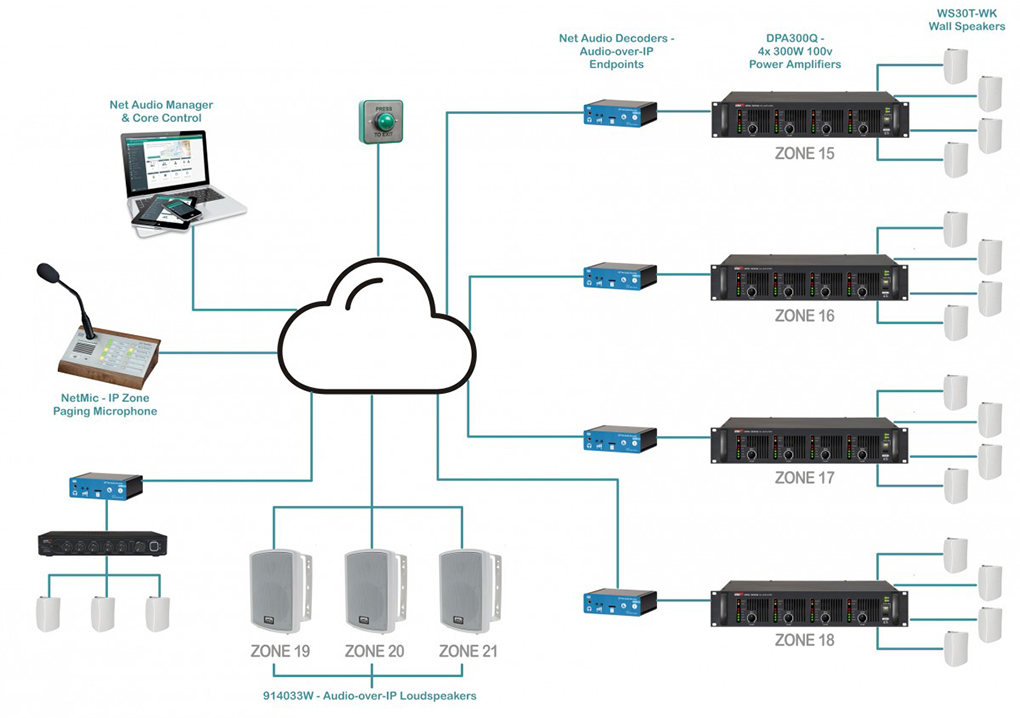
Example of an Audio-over-IP & Lockdown System
What are the benefits of AV over IP?
AV over IP is evolving key aspects such as:
- Scalable switching (the number of sources attached is no longer as limited, when physical ports run out, multiple IP switches can be connected to expand).
- Breaking the distance barriers
- Better ratio of inputs to outputs
- Video standards extend beyond the local facility
- Convergence with data and communications
- New options in video processing
How secure is AV over IP?
There is a common misconception that AV over IP introduces more security risks than conventional analogue AV. However this is not the case, there are encryption technologies for various aspects of IP products and they address multiple components of the AV system design.
Even though there are encryption technologies to offer security options to AV professionals, sometimes they are used to only reduce openness. To offer complete security the lockdown option may be chosen where the compatibility of the users encoders/decoders to just their own brand as a measure to limit the scope of their quality assurance testing, technical support and customer care options.
However having the knowledge and using a professional AV installer and technical support offered is a key part of maintaining the security of AV over IP networks.
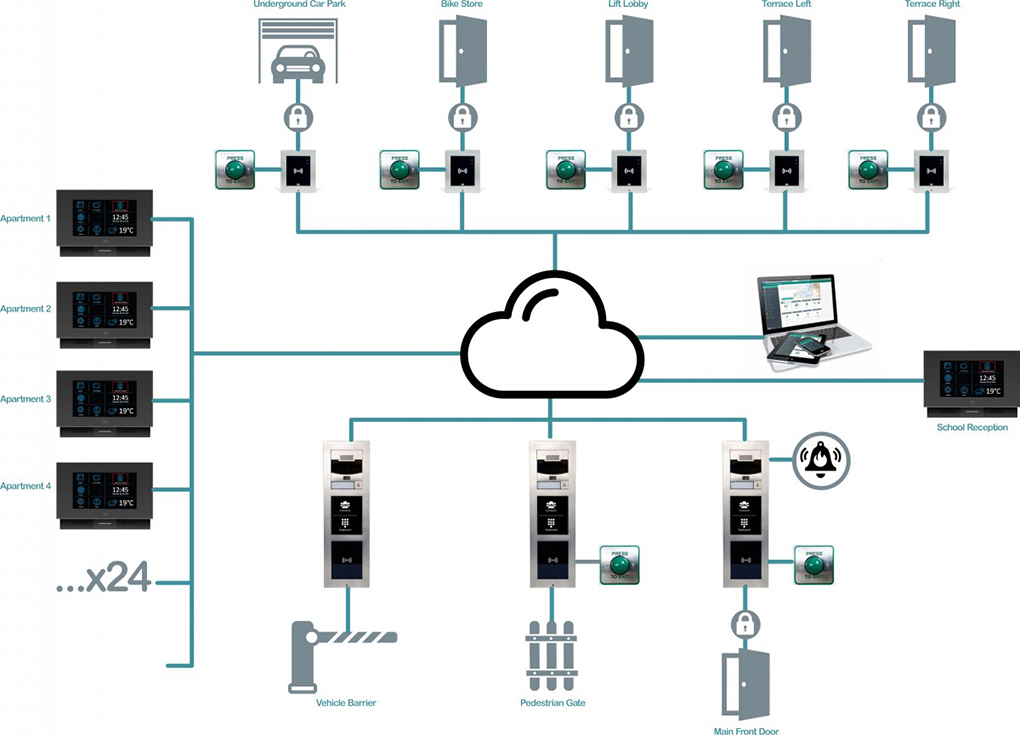
Example of a IP Door Intercom / Access Control System
Is there a single standard for AV-over-IP?
No! There are a huge range of AV-over-IP standards, transmission technologies and interfaces to transmit video, audio, control and data signals over a network for AV, professional audio and security applications.
Some of these platforms have been developed by technology alliances and the platforms have been licensed out to all manufaturers to integrate into their own technologies (such as HDBaseT, SDVoE, ONVIF).
In principal, this means that products from different manufacturers who use the same AV over IP transmission technology should be compatible – and, in some cases, they are! However, don’t always assume that every HDBaseT or ONVIF device will talk to every other HDBaseT or ONVIF device. The manufacturers would really prefer you to stay brand loyal and so will invest in their own product compatibility, rather than inter-brand co-operation!
Other protocols are industry-standard – such as VoIP, SIP, RTSP – and, therefore, will ensure a much greater level of compatibility between devices, brands and systems; for instance, many telephone, door intercom and IP audio systems will all use the same SIP protocol, allowing for large scale integrated system compatibility.
And then there are the hundreds (if not thousands!) of manufacturers’ own proprietary over-IP platforms! Licensed platforms are extremely expensive and so many technology manufacturers will simply develop their own audio, video or CCTV over-IP platform. In such cases, of course, there will be little or no compatibility with other third-party IP devices.
Which is better; AV-over-IP or conventional analogue AV?
For smaller systems, analogue AV will probably remain the preferred choice for the time being as a simple and cost effective solution. However for larger, more complex systems that require higher bandwidth, longer distance transmission or even plans for future expansion, the flexibilityof AV-over-IP offers a preferred solution and there is no doubt that AV/IP technology is the future of AV system transmission and control.