NFC Keyless Entry for Access Control and Door Intercoms
What is NFC Access Control?
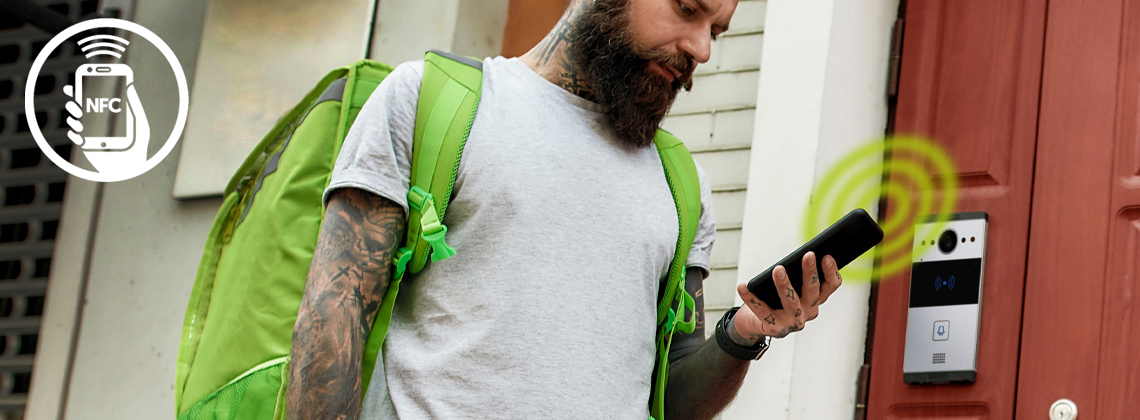
NFC Access Control (an acronym for Near Field Communication) allows for keyless and frictionless door entry using a smart phone device for authentication.
This short-range transmission radio frequency technology is a standard feature of most smart phones and is the same technology used for contactless payments from your phone or smart watch.
Access and Intercom system manufacturers are now incorporating NFC reader technology into access control and door intercom devices as a standard option as the trend for secure, convenient, wireless door unlocking becomes a growing requirement for residential and commercial users.
This trend is particularly prevalent in MDU (multi dwelling unit) developments – apartments and flats – multi-tenant office buildings and now, increasingly, in shared office co-worker spaces where 24 hour access is increasingly available and a younger, tech-savvy demographic has an expectation of contactless authentication such as payments, ticketing and now access control.
The benefits of NFC contactless door entry and access control
-
 Keyless door access
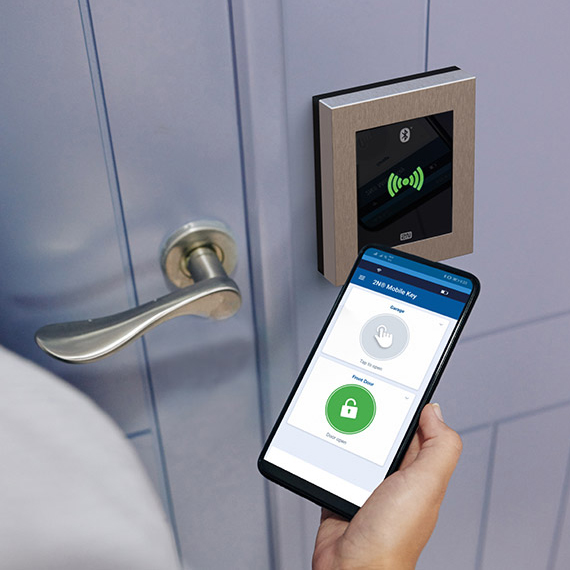
We’ve all forgotten or lost our keys at one time or another, but increasingly, you won’t find yourself leaving the house without having your ‘essential’ mobile phone in your hand! Smart phones have become so valuable to us all, both monetarily and in the level of data and day-to-day convenience of their limitless functionality, that adding access / door unlocking as a function to your ‘phone will quickly become an expectation of younger generations.
-
Convenience
As well as forgetting our keys, ID cards and passes are also easily forgotten or left on the desk at break, leaving you outside in the cold! NFC access ensures that as long as you have your phone to hand, you can get back in through the door.
-
Standard smart phone technology
NFC technology is now a standard transmission feature of most modern smart phones; therefore allowing easy connectivity of most phone and access control devices and brands.
-
Frictionless door entry
Frictionless technologies & systems are seeing a huge growth in popularity since the Coronavirus pandemic, as building managers look to reduce the number of high-frequency ‘touch points’ likely to spread the virus between workers or residents. NFC is a wireless transmission technology which allows the user to unlock the door from their smart phone without making physical contact with the access point device.
-
Reduced environmental impact
Keyless entry – such as NFC, RFID and Bluetooth – removes the need for physical keys, ID cards or keyfobs and, therefore, reduces plastics and material useage. In applications such as hotel room keys, for instance, where a key card is very often single-use before being disposed of, the reduction in plastics very quickly becomes a significant environmental factor.
-
Cost effective
This reduction in keys, key cards and ID passes, therefore, can also provide significant cost savings as the entry authentication device is the user’s own smart phone.
-
Improved security and data management
In situations where lost and forgotten ID passes is an everyday occurrence, the likelihood is that ‘tailgating’ colleagues or other students to get through the door becomes standard practice! Such practices can have a serious effect on personnel data management, impacting health & safety and security measures in the building.
What is NFC technology?
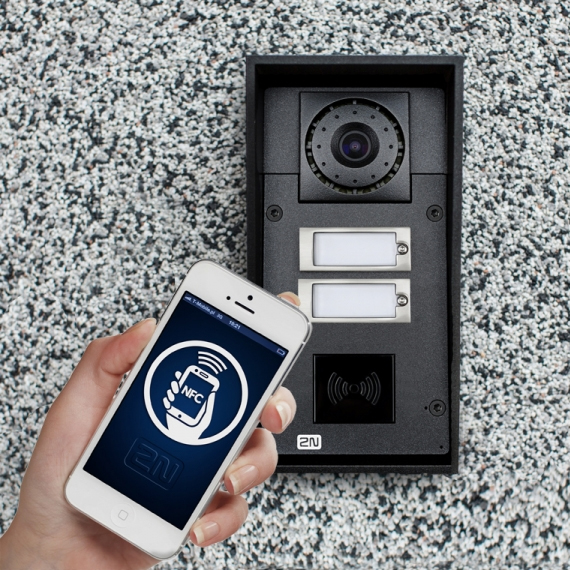 NFC is a wireless technology /short range communication data transfer method, it detects and enables technology that is a distance of 4cm or less (all without the need for internet connection). It requires another device to receive the signal.
How does NFC work?
Just like other wireless signals/methods, NFC works by sending information over radio waves. NFC evolved from RFID, it has one chip that operates as one part of a wireless link when another chip activates it – small amounts of data can transfer between the two devices when they are held a few cm’s away from each other.
NFC doesn’t use much power which makes it a much more efficient wireless communication type. NFC works by identifying us by our enabled cards/devices e.g. our bank accounts and other personal details.
Passive NFC devices:
Passive NFC devices, such as tags and small transmitters, can send information to other NFC devices without a power source. However they cannot process information sent from other sources or connect with other passive components. These are often in the form of interactive signs/adverts.
Active NFC devices:
Active NFC devices such as smart phones can both send and receive data and communicate with other active NFC’s as well as passive ones. Public transport card readers and contactless payment terminals are also another example of active NFC technology.