Understanding the Lifecycle Cost of a Public Address & Voice Alarm (PAVA) System
When choosing a Public Address and Voice Alarm (PAVA) system, it’s not just the upfront cost that matters. These systems are built for critical environments, running 24/7 and expected to last at least 10–15 years.
That’s why considering the total cost of ownership (TCO) – covering everything from purchase and installation to long-term maintenance, energy use, and upgrade paths – is key to making the right investment.
“We often see projects where the lowest-cost system ends up being the most expensive in the long run. Considering lifecycle cost from the start ensures you’re investing in reliability, not just buying hardware.” Andrew Short, CIE PAVA Technical Team
Why Whole-Life Costs Matter
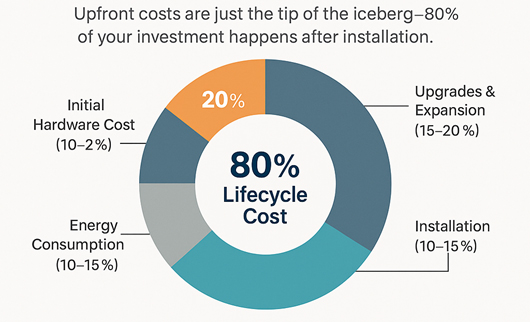
The initial purchase price of a PAVA system usually represents just 20% of the total lifecycle cost. The remaining 80% comes from operational expenses such as maintenance, support, energy consumption, and downtime recovery.
Choosing the right system and supplier can dramatically reduce these ongoing costs, providing long-term value and sustainability.
Key Factors to Consider in PAVA System Lifecycle Cost
1. Maintenance & Downtime Reduction
Ongoing service interruptions can quickly add up in both cost and risk. That’s why modern PAVA systems should simplify maintenance and minimise downtime:
- Hot-swappable components allow parts to be replaced without interrupting service.
- Remote monitoring reduces costly on-site visits by allowing system checks and adjustments to be carried out off-site.
- Modular design (such as Zenitel’s VIPEDIA platform) makes it easier to replace and configure individual modules without major disruption.
By taking a proactive approach with advanced diagnostics, faults can be identified and resolved before they become expensive problems.
“Downtime is not an option in safety-critical environments. Our approach is to engineer systems with redundancy and predictive diagnostics so faults are detected — and often resolved — before the client even knows there’s an issue.” Andrew Short, CIE PAVA Technical Team
2. Upgradability & Longevity
PAVA systems are long-term investments. Choosing a platform that supports phased upgrades and backward compatibility ensures the system evolves with your organisation’s needs — without the cost of a full replacement. Zenitel’s VIPEDIA architecture, for example, is compatible with its legacy V400 range and integrates seamlessly with third-party systems. Built with high-quality components, Zenitel systems are designed to last well over a decade, further reducing replacement and maintenance costs.
“A well-designed PAVA system should be scalable. With Zenitel’s modular architecture, clients can expand or upgrade over time without ripping out their entire infrastructure.” Pete George, CIE PAVA Specialist
3. System Reliability
For critical safety systems, reliability isn’t optional — it’s essential. Unplanned downtime can be costly and dangerous.
Zenitel PAVA solutions are engineered with:
- Redundant components to ensure continuous operation.
- High-availability clusters with standby controllers to protect against system or hardware failure.
- Built-in hardware bypass and secure network redundancy, keeping systems operational even if individual devices fail.
This level of resilience ensures communications remain available when they’re needed most – whether in transport hubs, stadia, commercial buildings, or industrial sites.
4. Compliance & Peace of Mind
A critical factor often overlooked is compliance with safety regulations and EN54 standards. Non-compliant systems can delay approvals and lead to costly redesigns.
Zenitel PAVA solutions are fully EN54-16 and EN54-4 compliant, ensuring they meet international fire and safety codes and satisfy consultants and local authorities.
“Specifiers need assurance that their systems meet EN54 requirements and local fire codes. We work closely with consultants to ensure every design passes compliance checks first time.” Pete George, CIE PAVA Specialist
5. Energy Efficiency
Lowering energy use isn’t just good for sustainability — it directly reduces operating costs.
Zenitel’s amplifiers use ‘sleep technology’, consuming minimal power when idle while remaining ready for use. For example, a V2000 amplifier module uses less than 25mA in idle mode, saving energy and extending battery life during power outages.
Less energy also means less heat, reducing the need for cooling infrastructure and lowering long-term operating costs.
6. Compact & Efficient Design
Rack space and infrastructure costs can quickly escalate. Compact, high-density designs reduce both equipment and space requirements.
Zenitel’s V2000 amplifier delivers up to 2,000W and 10 zones in a single compact 2U module — cutting rack-space requirements by up to 45% compared to alternative solutions.
Sample Lifecycle Cost Breakdown
Cost Component |
Typical Share of Total Cost |
Example Savings with Zenitel |
| Initial Hardware | ~20% | High-density modules reduce rack space & cabling costs |
| Installation | ~10–15% | Faster deployment with modular design |
|
Maintenance & Support |
~30–40% | Remote monitoring reduces on-site callouts |
|
Energy Consumption |
~10–15% | ‘Sleep mode’ amplifiers lower energy bills |
|
Upgrades & Expansion |
~15–20% |
Phased upgrades avoid costly full replacements |
Smarter Investment, Greater Value
Factoring in whole-life costs is essential when specifying a new Public Address and Voice Alarm system. By choosing a solution designed for reliability, maintainability, efficiency, compliance, and future upgrades, organisations can significantly lower long-term costs while ensuring safety and regulatory compliance.
Zenitel, available through CIE Group, delivers PAVA systems that meet these demands — helping organisations save thousands of pounds across a system’s lifetime.